A deer strike is one of the few car accidents where the insurance answer is fairly simple: it is usually a comprehensive claim. What makes it less simple is what happens around it, like whether you swerved, which deductible you picked, and whether you carry comprehensive at all.
Is hitting a deer comprehensive or collision?
Hitting a deer is typically a comprehensive claim, not collision. Auto policies split damage to your own car into two coverages. Collision pays when your car hits another object or rolls over. Comprehensive, which some insurers and regulators call "other than collision"[5], pays for most other damage, such as theft, fire, hail and falling objects[1].
AAA's Missouri sample policy, for example, lists the losses that count as "comprehensive not collision," and "contact with bird or animal" is one of them[1]. Progressive says the same: damage to your car from hitting a deer is covered by comprehensive[2]. State Farm says comprehensive typically covers damage from collisions with animals, subject to the policy terms and deductible[3].
That has two practical effects:
- Your comprehensive deductible applies, not your collision deductible. The policy takes off the deductible shown on your declarations page for that coverage[1], so check the comprehensive line.
- You need comprehensive on the policy. Progressive calls it optional, and required only if you lease or finance the car[2].
What if you swerve to miss the deer?
The coverage changes if your car hits something other than the animal. The same policy defines collision as "contact between an auto and another object" or upset of the car, meaning it overturns[1]. So if you swerve to miss a deer and hit a tree, a guardrail or another car, or roll the car, the damage to your car is a collision claim, paid only if you carry collision coverage[2].
Swerving can also change who is at fault. Progressive notes that if swerving to avoid a deer causes damage to others, the swerving driver may be found negligent[2]. And the comprehensive claim needs actual contact: your car must come in contact with the animal[2].
The second impact is often the dangerous part. IIHS says many fatal crashes that start with hitting an animal involve a second, more severe impact, such as hitting another vehicle or a tree[4].
Does liability insurance cover hitting a deer?
Not for your own car. Liability pays for damage you cause to other people and their property. Progressive says that if you only carry liability coverage, you likely won't be covered for hitting a deer[2]. If you swerve into another car, liability is what pays that driver, while the damage to your own car needs collision coverage.
Is hitting a deer an at-fault accident?
Usually not. Progressive says you're typically not considered at fault when you hit a wild animal[2]. Swerving is the exception to watch: if you swerve and damage someone else's car or property, you may be found negligent[2].
Will your insurance go up if you hit a deer?
It depends on your state and your insurer. Progressive says that in some states your rate won't increase if you hit a deer, because you're typically not considered at fault, but that a not-at-fault label does not guarantee your premium won't rise[2].
Should you file a claim?
Compare the repair estimate with your comprehensive deductible. You pay the deductible and the insurer covers the rest; if the car is totaled, comprehensive can pay out its actual cash value, minus the deductible[2]. If the repair costs little more than your deductible, the claim pays little.
How common animal collisions are, by state
State Farm estimates there were more than 1.6 million animal-vehicle collision claims across the US, all insurers included, between July 2025 and June 2026[3]. State Farm itself paid $1.9 billion in animal collision claim costs in that period[3]. It puts the national likelihood of an animal collision at 1 in 145, down from 1 in 139 a year earlier[3].
The likelihood is much higher in some states:
| State | Likelihood |
|---|---|
| West Virginia | 1 in 46 |
| Montana | 1 in 54 |
| Wisconsin | 1 in 62 |
| Pennsylvania | 1 in 64 |
| Michigan | 1 in 68 |
| US (national) | 1 in 145 |
210 people died in crashes with animals in 2024, according to the Insurance Institute for Highway Safety[4]. The federal crash data doesn't record which animal was hit. An older IIHS review of 147 fatal animal crashes in nine states, from 2000 to 2002, found 77% of the animals struck were deer[4].
State Farm says collisions happen especially in the fall, when deer are more active, and advises being especially alert from dusk to dawn.
How to lower the risk
State Farm's advice for drivers[3]:
- Be especially alert from dusk to dawn, when animals may be more active and visibility is reduced.
- Use high beams when appropriate.
- Brake, don't swerve. If an animal enters your path, brake firmly and stay in your lane when possible, because swerving can make you lose control or hit another vehicle.
- Always wear your seatbelt.
What to do if you hit a deer
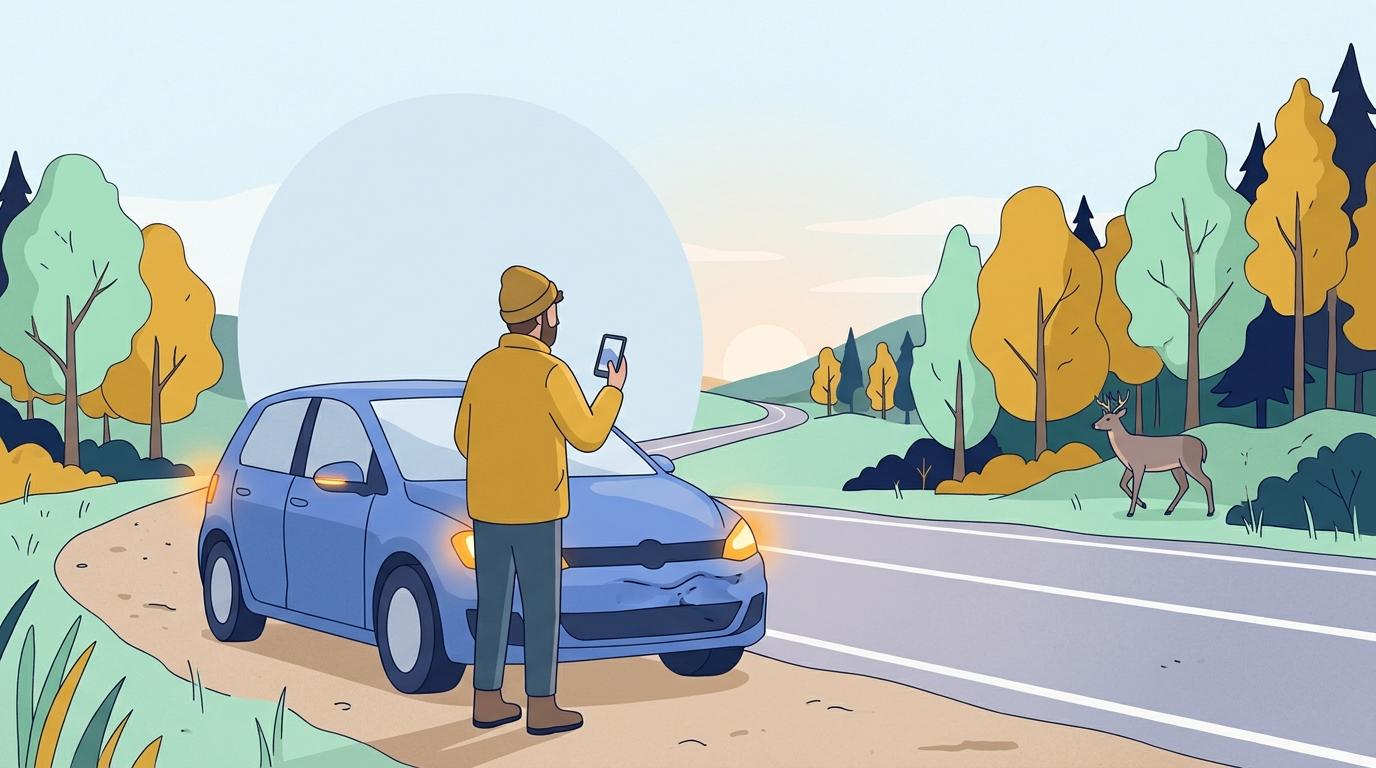
State Farm's advice, in order[3]:
- Move your car to a safe place if you can, and turn on your hazard lights.
- Call the police if the animal is blocking traffic or creating a hazard. Don't approach an injured or frightened animal.
- When it's safe, take photos of the scene and the damage.
- Before driving away, check for leaking fluids, damaged tires, broken lights or other hazards.
- Report the collision to your insurance company.
Your state may also have its own rules on reporting a crash to the police or DMV.
Check this before deer season
- Do you have comprehensive? Look at your declarations page. If it only lists liability, you would pay to fix your own car.
- What is the comprehensive deductible? That is your share of the repair. Comprehensive pays the rest, up to your car's actual cash value[2].
- Is your car financed or leased? Check the loan or lease terms, which may require comprehensive[2].
This page explains how auto policies are typically written. Your own policy wording and your state's rules decide your claim. It is not insurance advice, and we are not an insurance agent.
Common questions
Is hitting a deer comprehensive or collision?
Comprehensive, in most policies. AAA's Missouri sample policy, for example, lists contact with a bird or animal among the losses that count as comprehensive, not collision. Collision is defined as contact with another object or the car overturning.
Does car insurance cover hitting a dog or other animal?
The same rule applies. The policy wording covers contact with a bird or animal under comprehensive, so it is not limited to deer. You need comprehensive on your policy, and your comprehensive deductible applies.
Can hitting a deer total your car?
Yes. Progressive says speed, point of impact, car size and animal size all play a role in how much damage a car takes. If it is totaled, comprehensive can pay out the actual cash value of your car, minus the deductible.
Should I call the police after hitting a deer?
Call them if the animal is blocking the road or creating a hazard, as both State Farm and Progressive advise, and don't approach an injured animal. Your state may also have its own crash-reporting rules.
What if I swerved and never touched the deer?
Then comprehensive doesn't apply. Progressive says your car must come in contact with the animal for the comprehensive claim. If you hit something else while swerving, that damage falls under collision coverage, if you carry it.
When are deer collisions most common?
In the fall. State Farm says collisions happen especially in the fall, when deer are more active, and advises being especially alert from dusk to dawn.
Sources
- [1] Automobile Club Inter-Insurance Exchange (AAA): Missouri Personal Auto Policy, sample form 139 05 2011 (one insurer's sample form) · accessed 2026-11-12
- [2] Progressive: Does insurance cover hitting a deer? (updated Feb 29, 2024) · accessed 2026-11-12
- [3] State Farm newsroom: 20 years of animal collision data (Sept 15, 2026; data July 2025 to June 2026) · accessed 2026-11-12
- [4] IIHS: Fatality Facts 2024, collisions with fixed objects and animals · accessed 2026-11-12
- [5] Texas Department of Insurance: Auto insurance glossary · accessed 2026-11-12